

By: Matthew D. Dyer
In the New Testament and the Greek Septuagint[1] we have the Greek word diaspora often translated into the English language as “scattered” or “dispersed”, and in this article I want to demonstrate how this Greek word when used in Scripture is only used referring to Israelite people in Old and New Testament. This can be important to realize because often times in the New Testament in passages such as 1st Peter 1:1, many Bible teachers state that this book is written to and about non-Israelites Christians converts, sometimes referred to as a “spiritual Israel”, rather than being specifically addressed to New Testament Christian Israelites. Before we look at some verses where this word appears, I want to quote a few concordances and lexicons concerning what they have to say concerning this Greek word diaspora. In James Strong’s The Exhaustive Concordance of the Bible he defines this Greek word as:
“διασπορά diasporá, dee-as-por-ah’; from G1289; dispersion, i.e. (specially and concretely) the (converted) Israelite resident in Gentile countries:—(which are) scattered (abroad).”
In The NAS Exhaustive Concordance it defines diaspora as:
“a dispersion (Israel in Gentile countries)”
In Thayer’s Greek Lexicon it defines diaspora as:
“διασπορά, διασπορᾶς, ἡ (διασπείρω, cf. such words as ἀγορά, διαφθορά) (Vulg.dispersio), a scattering, dispersion: ἀτομων, opposed to σύμμιξις καί παραζευξις, Plutarch, mor., p. 1105 a.; in the Sept. used of the Israelites dispersed among foreign nations…”
In E. W. Bullinger’s The Companion Bible he states the following concerning diaspora:
“Greek Diaspora = the Dispersion. Occurs three times; here, 1Pe_1:1 (“scattered “), and Jam_1:1 (“which are scattered abroad”; literally “in the Dispersion”).”
Before we look at how this word is used in the New Testament, let’s first look at the Greek Septuagint and see how this Greek word was used throughout the Old Testament. It appears seven times, and the first verse that this word appears in is in Deuteronomy 28:25 where is says:
“The Lord give thee up for slaughter before thine enemies: thou shalt go out against them one way, and flee from their face seven ways; and thou shalt be a dispersion in all the kingdoms of the earth.” (Brenton Septuagint Translation)
In this verse the English word “dispersion” is translated from the Greek word diaspora in this passage, and the context of this chapter is the blessings and curses of Israel keeping the Mosaic Covenant. So, the very first place this word is used is in the Bible is referring to Israelites. Now let’s look at Deuteronomy 30:3 where the word appears next in the Bible:
“If thy dispersion be from one end of heaven to the other, thence will the Lord thy God gather thee, and thence will the Lord thy God take thee.” (Brenton Septuagint Translation)
The English word “dispersion” is translated from the Greek word diaspora in this passage, and once again we have the word appearing and being used in the context of Israelites being gathered after the Lord had scattered them for their sins. Now let’s look at Nehemiah 1:8-9 where the prophet Nehemiah quotes part of Deuteronomy 30:3 where it says:
“Remember, I pray thee, the word wherewith thou didst charge thy servant Moses, saying, If ye break covenant with me, I will disperse you among the nations. But if ye turn again to me, and keep my commandments, and do them; if ye should be scattered under the utmost bound of heaven, thence will I gather them, and I will bring them into the place which I have chosen to cause my name to dwell there.” (Brenton Septuagint Translation)
The English word “scattered” is translated from the Greek word diaspora in this passage and is referring to the Israelites. The next time this word is used is in Psalms 147:3 where it speaks of the promise of gathering dispersed Israelites:
“The Lord builds up Jerusalem; and he will gather together the dispersed of Israel.” (Brenton Septuagint Translation)
The English word “dispersed” is translated from the Greek word diaspora in this passage, and even more clearly is referring to Israelites. Now let’s look at Isaiah 49:6 where it says:
“And he said to me, It is a great thing for thee to be called my servant, to establish the tribes of Jacob, and to recover the dispersion of Israel: behold, I have given thee for the covenant of a race, for a light of the Gentiles[2], that thou shouldest be for salvation to the end of the earth.” (Brenton Septuagint Translation)
The English word “dispersion” is translated from the Greek word diaspora in this passage andis referring only to Israelites. It is also important to point out the usage of the Greek word genos in the Septuagint in this passage which is translated into the English word “race”, which is clearly speaking of the race of Israel in this context. The Greek word genos is defined by Strongs as “γένος génos, ghen’-os; from G1096; “kin” (abstract or concrete, literal or figurative, individual or collective):—born, country(-man), diversity, generation, kind(-red), nation, offspring, stock.” This Greek word also appears in the New Testament in 1st Peter 2:9 where it says:
“But ye are a chosen generation, a royal priesthood, an holy nation, a peculiar people; that ye should shew forth the praises of him who hath called you out of darkness into his marvellous light:” (King James Bible)
The NASV even translates this Greek word genos as “race” in this passage. Sadly, this verse is often taught to be referring to a “spiritualized” Israel made up of anyone who is a Christian, even though this Greek word being used is speaking of a race of people, and Peter is quoting Deuteronomy 7:6 in 1st Peter 2:9 which is speaking concerning the Israelites, and in 1st Peter 2:10 Peter is quoting a verse from the book of Hosea[3] concerning the Israelite people. As a side note, for those who say that the “concept” of race is not in the Bible, are incorrect. Now let’s look at Jeremiah 15:7 where the Greek word diaspora appears next:
“And I will completely scatter them; in the gates of my people they are bereaved of children: they have destroyed my people because of their iniquities.” (Brenton Septuagint Translation)
The English word “scatter” is translated from the Greek word diaspora in this passage and is referring to the Judean Israelites of Jerusalem. The Apostolic Bible Polyglot translation words this verse in the following manner which I believe is clearer:
“And I will scatter them in a dispersion in the gates of my people. They were made childless; they destroyed my people because of their evils.” (The Apostolic Bible Polyglot LXX)
In this translation diaspora is translated as “dispersion.” The last verse in the Old Testament to use the Greek word diaspora is Jeremiah 34:17 which says:
“On account of this, thus said the LORD, You hearkened not to me to call a release — each for his brother, and each for his neighbor. Behold, I call a release to you — to the sword, and to the plague, and to the famine; and I will give you for dispersion unto all the kingdoms of the earth.” (The Apostolic Bible Polyglot LXX)
The English word “dispersion” is translated from the Greek word diaspora in this passage, and once again it is speaking of the Israelite people. So, throughout the Old Testament every time this word is used it is speaking of Israel ONLY. So, by using this reasoning it would make sense that in the New Testament this same Greek word would also be used exclusively for Israelites. But before looking at where this word appears in the New Testament, I want to point out that this Greek word is consistently used for Israelites in the Apocrypha as well. Now even though I do not beleive the Apocrypha as inspired Scripture, it does give us more witnesses to how this Greek word diaspora was being used in the 2nd century B.C. up to the 1st century A.D. In the book of Judith chapter 5 verse 19 it says this speaking of the Israel people:
“But now are they returned to their God, and are come up from the places where they were scattered, and have possessed Jerusalem, where their sanctuary is, and are seated in the hill country; for it was desolate.” (Brenton Septuagint Translation)
The English word “scattered” is translated from the Greek word diaspora in this passage. If we look at the book of 2nd Maccabees in chapter 1 verse 26-27 it says this concerning the Israel people:
“Receive the sacrifice for thy whole people Israel, and preserve thine own portion, and sanctify it. Gather those together that are scattered from us, deliver them that serve among the heathen, look upon them that are despised and abhorred, and let the heathen know that thou art our God.” (Brenton Septuagint Translation)
As you have probably guessed it, the English word “scattered” is translated from the Greek word diaspora in this passage. We have examined every verse in the Greek Old Testament where the word diaspora appears and revealed that it is always used referring to scattered Israelites. It is never used for a non-Israelite people. Now let’s look at John chapter 7 verses 32-35 where this word first appears:
“The Pharisees heard that the people murmured such things concerning him; and the Pharisees and the chief priests sent officers to take him. Then said Jesus unto them, Yet a little while am I with you, and then I go unto him that sent me. Ye shall seek me, and shall not find me: and where I am, thither ye cannot come. Then said the Jews among themselves, Whither will he go, that we shall not find him? will he go unto the dispersed among the Gentiles, and teach the Gentiles?” (King James Bible)
The English word “dispersed” is translated from the Greek word diaspora. In this passage the Judeans of Jesus’ day were wondering whether or not Jesus would go to the “dispersed” that were among the “Gentiles” and teach them. As I have demonstrated, this word always means Israelites that are scattered in other countries outside of the land of Israel. If you are reading this verse out of the King James Version, it possesses a stumbling block because of the two words translated as “Gentiles” that should have been translated as Greeks. The two Greek words here are the word ellēn, which is the Greek word for the Greeks. This mistake wasn’t made by the translators of the 1599 Geniva Bible which says:
“Then said the Jews among themselves, Whither will he go, that we shall not find him? Will he go unto them that are dispersed among the Greeks, and teach the Greeks?” (1599 Geneva Bible)
What this verse is telling us is the Judeans of the time of Jesus believed and knew that dispersed Israelites were among the Greeks. They were not thinking of a non-Israelite people, rather they were thinking of people from their own lineage that had been scattered. But first let’s look at James chapter 1 verse 1 which is the next time the word diaspora appears:
“James, a servant of God and of the Lord Jesus Christ, to the twelve tribes which are scattered abroad, greeting.” (King James Bible)
The English word “scattered” is translated from the Greek word diaspora in this passage. This verse is very clear that James is speaking about the twelve tribes of Israel, which is consistent with every verse we have looked at so far. The last verse in the New Testament to use diaspora is 1st Peter 1:1 which states:
“Peter, an apostle of Jesus Christ, To those who reside as aliens, scattered throughout Pontus, Galatia, Cappadocia, Asia, and Bithynia, who are chosen” (King James Bible)
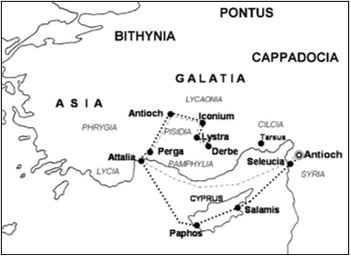
The English word “scattered” is translated from the Greek word diaspora in this passage. Peter chose to use this word because his epistle was addressed to scattered flesh and blood Christian Israelites in the regions of “Pontus, Galatia[4], Cappadocia, Asia, and Bithynia” rather than the commonly held belief that Peter is addressing his epistle to a “spiritual” Israel or just Christians in general. Peter was using this Greek word the same way he would have read it in the Greek Old Testament, which was used during his day, and he would have been very familiar with it. This is even further demonstrated by what he says in 1st Peter 2:9-10 which we discussed earlier in this article.
If we look back through Biblical history we know that the nation of Israel was split into two nations (1st Kings 11:29-36) and the northern part of Israel became known as the kingdom or house of Israel, and the southern part was known as the kingdom or house of Judah. The other two tribes of Judah and Benjamin, with most of the tribe of Levi, formed the southern kingdom, with the majority of the remainder of the Israelites forming the northern kingdom of Israel. After this division of kingdom of Israel into two kingdoms, the Israelite people went deeper into sin, and they forgot or didn’t care about the warnings that God had given them back in Deuteronomy 28. The first verse we looked at in this article that contained the Greek word diaspora was Deuteronomy 28:25 where God said he would disperse/scatter Israel among the kingdoms of the earth for being disobedient unto the covenant that He made with them.
“The Lord give thee up for slaughter before thine enemies: thou shalt go out against them one way, and flee from their face seven ways; and thou shalt be a dispersion in all the kingdoms of the earth.” – Deuteronomy 28:25 (Brenton Septuagint Translation)
“And the Lord shall cause thee to fall before thine enemies: thou shalt come out one way against them, and shalt flee seven ways before them, and shalt be scattered through all the kingdoms of the earth.” – Deuteronomy 28:25 (1599 Geneva Bible)
“The LORD shall cause thee to be smitten before thine enemies: thou shalt go out one way against them, and flee seven ways before them: and shalt be removed into all the kingdoms of the earth.” – Deuteronomy 28:25 (King James Bible)
God Almighty kept His promise when the Assyrians came against the northern kingdom of Israel and defeating them in battle and carried them away captive into Assyria. These Israelites were put into Halah, and in Habor by the river Gozan, and in the cities of the Medes. God made these people a diaspora people, or in other words an Israelite people in a foreign country other than their own as a punishment for their sins. The house of Israel was divorce from God when this happened, but the nation of Judah remained in covenant with God even though she wasn’t any better than her sister Israel (Jeremiah 3:8-10). But even though all this happened there was a promise for these scattered Israelites that they would be brought back together under a New Covenant in Jeremiah 31:31-33 which says:

“Behold, the days come, saith the LORD, that I will make a new covenant with the house of Israel, and with the house of Judah: Not according to the covenant that I made with their fathers in the day that I took them by the hand to bring them out of the land of Egypt; which my covenant they brake, although I was an husband unto them, saith the LORD: But this shall be the covenant that I will make with the house of Israel; After those days, saith the LORD, I will put my law in their inward parts, and write it in their hearts; and will be their God, and they shall be my people.” (King James Bible)
In Ezekiel 34:1-16, we have the prophet speaking about God’s sheep, who are the Israel people, and how these sheep are “scattered upon all the face of the earth” and were in need of a shepherd. Later on in verse 11-12 it says:
“For thus saith the Lord God; Behold, I, even I, will both search my sheep, and seek them out. As a shepherd seeketh out his flock in the day that he is among his sheep that are scattered; so will I seek out my sheep, and will deliver them out of all places where they have been scattered in the cloudy and dark day.” (King James Bible)
God Almighty is saying in these verses that He would come and seek out His scatter sheep which were lost. This is also promised in Jerimiah 31:10 where it says:
“Hear the word of the LORD, O ye nations, and declare it in the isles afar off, and say, He that scattered Israel will gather him, and keep him, as a shepherd doth his flock.” (King James Bible)
Jesus Christ being God[5] in the flesh came to the earth as this shepherd to gather up His sheep. It was Jesus who said in John 10:11 that He was “…the good shepherd: the good shepherd giveth his life for the sheep.” Later, in that chapter in verse 16 Jesus also stated that He had other sheep in another fold.
“And other sheep I have, which are not of this fold: them also I must bring, and they shall hear my voice; and there shall be one fold, and one shepherd.” (King James Bible)
Throughout Scripture the word sheep is only ever used to refer to the Israelites. The other fold of sheep Jesus is speaking of is the scattered/dispersed house of Israel that was promised to be regathered and given a New Covenant. We read about this regathering of the Israelite people and them coming together under one head (one shepherd) again in the book of Hosea chapter 1 verse 9-11 where it says:
“Then said God, Call his name Loammi: for ye are not my people, and I will not be your God. Yet the number of the children of Israel shall be as the sand of the sea, which cannot be measured nor numbered; and it shall come to pass, that in the place where it was said unto them, Ye are not my people, there it shall be said unto them, Ye are the sons of the living God. Then shall the children of Judah and the children of Israel be gathered together, and appoint themselves one head, and they shall come up out of the land: for great shall be the day of Jezreel.” (King James Bible)
In the context of the Bible there is only one people, who are called God’s sheep, who were “scattered” and not in the land of Judah at the time of the New Testament, that were promised to be regathered under one head/shepherd and given a New Covenant. That was the Israelite people from the northern house of Israel, which after they left their Assyrian captivity changed their names over the centuries and migrated into western Europe. The 1st century Judean historian Josephus confirmed the fact that the house of Israel (ten tribes of Israel) were still in existence when he said:
“The ten tribes are beyond the Euphrates till now, and are an immense multitude and not to be estimated in numbers”[6]

There was only one group of people who had traveled beyond the area of the Euphrates, near where they were held captive, and had grown into an immense multitude of people like was prophesied in Scripture. It was the Anglo-Saxon, Celtic, Germanic, Scandinavian and kindred peoples of Europe. The same people that accepted Christianity and it grew among them for the last 2000 years, and the Word of God was kept and printed and sent out to the world by them. Even though it may not be something that our modern culture wants to accept, no one can deny that the Gospel of Jesus Christ went north-west into Europe right after the death, burial, and resurrection of our Lord and was accepted and heard by those sheep that dwelt there just as Jesus said would happen in John 10:27 when He stated:
“My sheep hear my voice, and I know them, and they follow me.” (King James Bible)
[1] The Septuagint is the Old Testament translated into Greek.
[2] The English word “Gentiles” here is translated from the Greek word ethnos, which means simply nations, and one must look at the context to determine which nations the passage is speaking about. It is translated as nations in this passage in the The Apostolic Bible Polyglot (LXX).
[3] Read Hosea 1:9, 1:10, 2:23
[4] Please see my article titled Yeah But, the Bible says “Neither JEW nor GREEK at my website www.ChristianAmericaMinistries.org where I prove how the people of Galatia where Celtic people, who Peter is identifying as Israelites.
[5] For more Scriptural proof that Jesus is God please read Is Jesus God? Or A God? by Matthew D. Dyer. A hardcopy can be ordered or read for free at http://www.ChristianAmericaMinistries.org.
[6] Antiquities of the Jews 11:133

 Christian America Ministries