By: Matthew D. Dyer
After the mode of Biblical baptism is identified, one must ask the question who and when is someone to be baptized, and this often leads to the subject of infant baptism. The debate on whether infants should be baptized (immersed), poured, or sprinkled has been going on since at least the 2nd or 3rd century. I don’t expect the next few pages to convince everyone that are on the fence of this issue, but I do hope and pray that I will at least make the reader stop and study into this matter in more detail and look at it biblically, if they haven’t done so already.

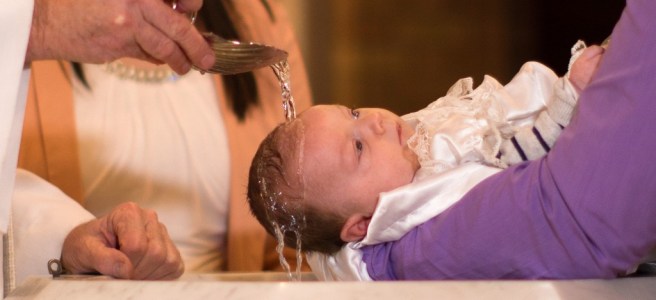
First off, very rarely does any Church perform actual infant baptism, as in immersion in water. It is normally sprinkling or pouring of water over the infant which they identify as baptism. Infant baptism in theological terms is called “paedo-baptism.” The word paedo is the Latin word for child. This belief is contrasted with what is known as “credobaptism.” The word credo is the Latin word for “I believe” and is where we get our English word creed from. So, credobaptism is the baptism of someone who can and does believe. Churches such as the Roman Catholics, Eastern Orthodox, Lutherans, Methodists, and Presbyterians all practice forms of paedobaptism. In most Churches this act is performed by a bishop or pastor on the 8th day of the baby’s life and is believed to be a direct New Covenant replacement for Old Testament circumcision regardless of the infant being male or female. Below is an example of what the 1647 Westminster Confession of Faith says concerning baptism, which is primarily used in Reformed Presbyterian churches today:
“3. Dipping of the person into the water is not necessary; but Baptism is rightly administered by pouring or sprinkling water upon the person. 4. Not only those that do actually profess faith in and obedience unto Christ, but also the infants of one or both believing parents, are to be baptized.”
Right away you should notice that this confession denies that biblical baptism is by water immersion, which I addressed in the previous chapter. This is unfortunate. But concerning those who should be “baptized,” the confession states that not only adults who can profess faith, but also infants should be “baptized.” The issue with this point of view is there is NOT ONE example in all of Scripture of infant baptism taking place, or being taught, or even hinted to, yet there are many examples of credobaptism. The chart below is taken out of Rev. James Mountain’s My Baptism, And What Led to It, and displays the reality of infant baptism in the Scriptures.

The following Scriptures display how the one being baptized has to be able to believe and repent of their sins, something an 8-day old infant simply cannot do.
Acts 2:37-38 states:
“Now when they heard this, they were pricked in their heart, and said unto Peter and to the rest of the apostles, Men and brethren, what shall we do? Then Peter said unto them, Repent, and be baptized every one of you in the name of Jesus Christ for the remission of sins, and ye shall receive the gift of the Holy Ghost.”
The people listening to Peter preach on the day of Pentecost were convicted by what they had heard, the New Testament describes it as they were “pricked in their heart” and then they believed and had faith enough to ask Peter what shall they do. Then Peter commanded them to repent (this means to change or turn away) and be immersed in the name of Jesus Christ. Verse 41 confirms that they “received his words” and obeyed. None of which an infant can do.
A common objection to this passage from Paedo-Baptist is that verse 39 of this chapter speaks of children, and they assume this must mean infants who are 8 days old, and the promise is baptism.
Act 2:39 states:
“For the promise is unto you, and to your children, and to all that are afar off, even as many as the Lord our God shall call.”
Please note that not all children are 8 days old, or even infants. So, to say that Peter is referring to paedo-baptism is a big assumption. Infants cannot believe, cannot be convicted of their sins and repent, and therefore cannot do what Peter is speaking about in verse 38.
Acts 8:12-13 states:
“But when they believed Philip preaching the things concerning the kingdom of God, and the name of Jesus Christ, they were baptized, both men and women. Then Simon himself believed also: and when he was baptized, he continued with Philip, and wondered, beholding the miracles and signs which were done.”
In this passage we have men and woman who believed the Gospel and were baptized. We do not know if there were children present in this passage, but if they were it would have been a good place to have “and children” to settle the paedo-baptist position once and for all. But the Scripture does not say that.
Acts 8:18 states:
“And Crispus, the chief ruler of the synagogue, believed on the Lord with all his house; and many of the Corinthians hearing believed, and were baptized.”
Acts 19:5 states:
“When they heard this, they were baptized in the name of the Lord Jesus.”
In both of these passages we have adult believers hearing the Gospel and acting on what they had heard through their faith and belief. This is something an infant cannot do.
Acts 16:14-15 states:
“And a certain woman named Lydia, a seller of purple, of the city of Thyatira, which worshipped God, heard us: whose heart the Lord opened, that she attended unto the things which were spoken of Paul. And when she was baptized, and her household, she besought us, saying, If ye have judged me to be faithful to the Lord, come into my house, and abide there. And she constrained us.”
In this passage we have a woman named Lydia who heard the preaching of the Gospel, and it says that the Lord opened her heart to receive what she had heard, and when she did, she was baptized along with her household. Many assume that her household was in attendance to Paul’s preaching, or perhaps Lydia shared the Gospel with them at a later time. This passage is often used by adherents of paedobaptism as a proof text for infant baptism, because they assume there must have been at least one infant in her household. This is a weak argument, and an argument from silence. I recently preached a sermon on baptism and brought up this verse and how it is used for advocating infant baptism, and in the audience while I was preaching there were several “households” in attendance and the only household that currently had an infant was my own. So, assuming Lydia’s household must have had an infant is not a sound argument.
Acts 22:16 states:
“And now why tarriest thou? arise, and be baptized, and wash away thy sins, calling on the name of the Lord.”
In this passage we have the believer being commanded to arise and be baptized, implying this is an act of obedience. It is true that when one is baptized, it is something that is done to them when they are immersed in water, but it is that person who decided to arise and go be baptized in the first place. When an infant is baptized, they don’t know what is happening to them, and when they are an adult won’t remember it. This verse also speaks of the believer calling on the name of the Lord. Obviously, an infant, even if they could understand and believe, cannot do this either.
We also find in Acts 22:16 a command not to wait to be baptized. If you believe the Gospel, have faith in our Lord Jesus, then you are to be baptized in water as soon as possible just like the Christians did in the Book of Acts. There is no need to wait till next month when your Church can schedule a bunch of baptisms for one day and have a party or wait until things are not as busy in your life, or whatever excuses you can come up with. As a minister, I have had many people reach out to me and ask if I could baptize them, and I have always done everything in my ability to schedule it and make it happen ASAP. I have scouted out creeks or rivers nearby to the person’s home who is wanting to be baptized, rented a hotel room on more than one occasion to use their swimming pool, and even used a horse trough a few times. It saddens me though when people reach out to me, and I make myself available, and then I am given every lame excuse in the world on why they can’t be baptized now. I read the Scriptures to them, answer questions to the best of my ability, but I never pressure them into baptism, because it is between them and the Lord, not me and them.
Many reformed Christians, myself included, hold to the “Five Solas,”[1] which are a set of foundational Christian theological principles held by Reformed Christians today, and have their roots in the Protestant Reformation, and ultimately in Scripture. The five solas are: Solo Christo (Christ alone), Soli Deo Gloria (glory to God alone), Sola Fide (by faith alone), Sola Gratia (by grace alone), and Sola Scriptura (by Scripture alone). Sola Scriptura is the belief that we as Christians are to only receive doctrine from Scripture[2] alone, and that any doctrine or teaching that has it’s foundation outside of that is a tradition of man. Since the doctrine of paedobaptism cannot be found anywhere in Scripture, I believe that this doctrine must be placed into this category of a tradition and treated as such. Jesus warned us many times in the Gospel’s of traditions that make the Word of God of none effect, or in other words cancels it out. When the Bible clearly teaches that baptism is by immersion in water of a believer in Christ, who can have faith, and repent of their sins, and someone else comes along and says different, it is a tradition.
Jesus said in Matthew 15:3 these words:
“But he answered and said unto them, Why do ye also transgress the commandment of God by your tradition?”
Jesus said in Matthew 15:6 these words:
“And honour not his father or his mother, he shall be free. Thus have ye made the commandment of God of none effect by your tradition.”
Jesus said in Mark 7:7 these words:
“Howbeit in vain do they worship me, teaching for doctrines the commandments of men.”
Jesus said in Mark 7:13 these words:
“Making the word of God of none effect through your tradition, which ye have delivered: and many such like things do ye.”
[1] Sola is the Latin word for “alone.”
[2] The 66 books of the protestant Bible.

 Christian America Ministries