
By: Matthew D. Dyer
(This article is taken from the book A Case for Biblical Kinism)
Another common objection to biblical kinism by those who promote multiculturism is: “What about Rahab? She was a Canaanite, and they were forbidden to marry into. She is in the genealogy of Jesus, so this means Jesus comes from a mixed lineage and is part Canaanite.” If this is true, then it makes a lot of the laws against marrying into the Canaanite and other forbidden kindreds given to us by God to seem a bit foolish and confusing. One minute God says do not marry into these people, and the next minute He has these forbidden lineages in the genetic line of the Messiah which was supposed to be without spot or blemish. We read about Rahab in Joshua 2, and perhaps by reading where she first appears we can learn more about this woman:
Joshua 2:1-24 states:
“And Joshua the son of Nun sent out of Shittim two men to spy secretly, saying, Go view the land, even Jericho. And they went, and came into an harlot’s house, named Rahab, and lodged there. And it was told the king of Jericho, saying, Behold, there came men in hither to night of the children of Israel to search out the country. And the king of Jericho sent unto Rahab, saying, Bring forth the men that are come to thee, which are entered into thine house: for they be come to search out all the country. And the woman took the two men, and hid them, and said thus, There came men unto me, but I wist not whence they were: And it came to pass about the time of shutting of the gate, when it was dark, that the men went out: whither the men went I wot not: pursue after them quickly; for ye shall overtake them. But she had brought them up to the roof of the house, and hid them with the stalks of flax, which she had laid in order upon the roof. And the men pursued after them the way to Jordan unto the fords: and as soon as they which pursued after them were gone out, they shut the gate. And before they were laid down, she came up unto them upon the roof; And she said unto the men, I know that the LORD hath given you the land, and that your terror is fallen upon us, and that all the inhabitants of the land faint because of you. For we have heard how the LORD dried up the water of the Red sea for you, when ye came out of Egypt; and what ye did unto the two kings of the Amorites, that were on the other side Jordan, Sihon and Og, whom ye utterly destroyed. And as soon as we had heard these things, our hearts did melt, neither did there remain any more courage in any man, because of you: for the LORD your God, he is God in heaven above, and in earth beneath. Now therefore, I pray you, swear unto me by the LORD, since I have shewed you kindness, that ye will also shew kindness unto my father’s house, and give me a true token: And that ye will save alive my father, and my mother, and my brethren, and my sisters, and all that they have, and deliver our lives from death. And the men answered her, Our life for yours, if ye utter not this our business. And it shall be, when the LORD hath given us the land, that we will deal kindly and truly with thee. Then she let them down by a cord through the window: for her house was upon the town wall, and she dwelt upon the wall. And she said unto them, Get you to the mountain, lest the pursuers meet you; and hide yourselves there three days, until the pursuers be returned: and afterward may ye go your way. And the men said unto her, We will be blameless of this thine oath which thou hast made us swear. Behold, when we come into the land, thou shalt bind this line of scarlet thread in the window which thou didst let us down by: and thou shalt bring thy father, and thy mother, and thy brethren, and all thy father’s household, home unto thee. And it shall be, that whosoever shall go out of the doors of thy house into the street, his blood shall be upon his head, and we will be guiltless: and whosoever shall be with thee in the house, his blood shall be on our head, if any hand be upon him. And if thou utter this our business, then we will be quit of thine oath which thou hast made us to swear. And she said, According unto your words, so be it. And she sent them away, and they departed: and she bound the scarlet line in the window. And they went, and came unto the mountain, and abode there three days, until the pursuers were returned: and the pursuers sought them throughout all the way, but found them not. So the two men returned, and descended from the mountain, and passed over, and came to Joshua the son of Nun, and told him all things that befell them: And they said unto Joshua, Truly the LORD hath delivered into our hands all the land; for even all the inhabitants of the country do faint because of us.”
This is the principal story of Rahab helping the Israelites conquer Jericho. If you continue reading we see in Joshua chapter 6:17 that Joshua and the Israelites let her and her family live, and even allowed them to stay in the land, which was forbidden by God if she was of Canaanite lineage (Deuteronomy 7:1-3). Please notice that she is never identified as a Canaanite in this passage, or elsewhere in Scripture. Although her and her family lived in the Canaanite city of Jericho, it is speculation to identify her as a Canaanite from this fact alone. Much like it would be complete speculation to identify someone living in San Antonio, Texas, as a Mexican, or someone living in London, England, as a Caucasian.
As an example of someone being misidentified because of how they dressed or where they lived, we can see in the Book of Exodus that Moses was mistaken to be an Egyptian:
Exodus 2:18-19 states:
“And when they came to Reuel their father, he said, How is it that ye are come so soon to day? And they said, An Egyptian delivered us out of the hand of the shepherds, and also drew water enough for us, and watered the flock.”
It is very unlikely that Rahab was a Canaanite because God was blessing Joshua and the Israelites in battle, something God only did when the Israelites were obedient to God’s Law. Let’s now examine where Rahab appears in the New Testament:
Matthew 1:1, 5 states:
“The book of the generation of Jesus Christ, the son of David, the son of Abraham… And Salmon begat Booz (Boaz) of Rachab; and Booz begat Obed of Ruth; and Obed begat Jesse.”
It would seem at a surface reading of this passage that Rachab (often translated as Rahab) was the mother of Boaz, who married Ruth in the Book of Ruth, and this would mean that Boaz was born of Rahab after the conquest of Jericho. The dating of the conquest of Jericho is believed to have taken place around 1406 B.C. In Halley’s Bible Handbook written by Henry H. Halley, the following is stated:
“Jericho has been much excavated in the 20th century: by Warren, by Sellin and Watzinger, by Garstang, by Kenyon, and by an Italian team What John Garstang thought were the walls destroyed by Joshua turned out to actually be the walls of a city that existed about 1000 years before Joshua. However, Kathleen Kenyon’s negativism about the correlation of the biblical and archaeological data is also not warranted. Bryant Wood, in his analysis of all of the data, has reasonably suggested the following. What the archaeologists call City IV was destroyed about 1400 B.C. This date agrees well with the internal chronology of the Bible, which would place the conquest of Joshua at about 1406 B.C… It seems that City IV was first destroyed by an burnt debris, in some places three or more feet thick, has been found at various locations on the tell. Among the debris were pottery, household utensils, and even carbonized grain indicating that the destruction had taken place in the spring of the year, just after the harvest (2:6; 3:15; and note that Israel celebrated the Passover just before the conquest of Jericho, 5:10 and cf. 3:15). It also indicated that there had not been a long siege (large quantities of grain were found; the biblical texts say the city was taken within seven days, 6:15), and that the inhabitants did not have time to flee with their belongings before the destruction. In addition, carbon- 14 (C 14) tests on the organic material place the destruction at about 1400 B.C, Even Egyptian scarabs (seals) found in tombs there do not name pharaohs who ruled after 1400 B.C.” [1]
If the destruction of Jericho happened around 1406 B.C., this would mean David was born around 1036 B.C. Because the Bible tells us in 1 Kings 6:1 that “In the four hundred and eightieth year after the people of Israel came out of the land of Egypt, in the fourth year of Solomon’s reign over Israel…” So, if we take 480 and subtract 40 years for the Israelites wandering in the wilderness and subtract 70 years for the age of David (2 Samuel 5:4), we end up with 370 years between Jericho and David’s birth. This would mean that there are four generations that must be born within 370 years if Rachab in Matthew 1:5 is the same person as Rahab as in Joshua chapter 2. The timeline[2] on the following page demonstrates the possible time of these four generations, and that the Rachab in Jesus’ genealogy is a different Rahab then in Book of Joshua.
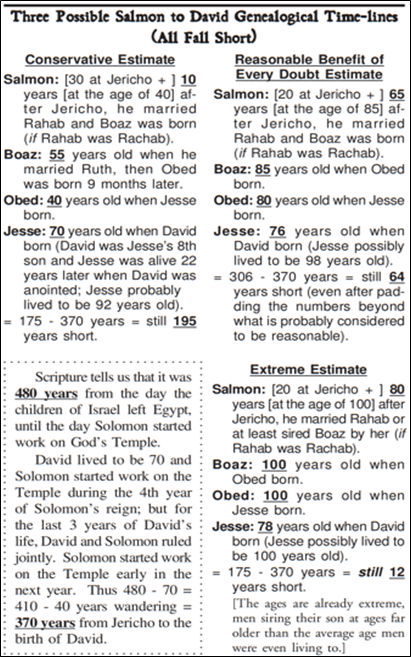
Another piece of evidence for the Rachab in Jesus’ genealogy not being the same person as Rahab, is in the New Testament two different Greek words are used for each name. In Matthew 1:5 the Greek word rachab[3] is transliterated in that passage, and in Hebrew 11:31 and James 2:25 uses the Greek word raab[4] which is translated as Rahab. This Greek word rachab does not appear anywhere in the Greek Septuagint, but the Greek word rahab is used in the Book of Joshua speaking of Rahab.It is very clear from the context of the passage in the Epistle to the Hebrews and the Epistle of James that they are speaking of Rahab in the Book of Joshua, but it appears the rachab in Jesus’ genealogy is a different woman with a similar name.
Rahab the Harlot?
As a supplementary thought on Rahab, I wanted to raise the question whether or not she was an active prostitute. It seems a bit odd that these Israelite spies find themselves staying in the house of a harlot, and one can imagine that this sounded really sketchy when these men were reporting back to Joshua and how they had found help in the home of a harlot or possibly a brothel, and that Joshua didn’t question these men’s loyalty. Some theologians believe that rather than being a harlot, she was either a former harlot who had repented, or a former harlot turned innkeeper.
Adam Clarke stated the following about Rahab in Clarke’s Commentary on the Bible on Joshua 2:1:
“A harlot’s house – Harlots and innkeepers seem to have been called by the same name, as no doubt many who followed this mode of life, from their exposed situation, were not the most correct in their morals. Among the ancients women generally kept houses of entertainment, and among the Egyptians and Greeks this was common.”
Rev. Joseph Benson stated the following about Rahab in Benson’s Commentary of the Old and New Testament on Joshua chapter 2:1:
“Although the Hebrew word זונה, zonah, here rendered harlot, does also sometimes signify an innkeeper, or one who sells provisions; yet, as the former is certainly the common meaning of the term, and the sense in which it must frequently be necessarily taken, (see Gen_34:31; Jdg_11:1; Hos_1:2,) and as Rahab is called a harlot by two apostles, (Heb_11:31; Jas_2:25,) who use an expression of no such equivocal meaning, it seems evident she had once been a harlot, though undoubtedly was now reformed.”
Matthew Henry stated the following about Rahab in Matthew Henry’s Commentary on the Whole Bible on Joshua 2:1:
“The providence of God directing the spies to the house of Rahab. How they got over Jordan we are not told; but into Jericho they came, which was about seven or eight miles from the river, and there seeking for a convenient inn were directed to the house of Rahab, here called a harlot, a woman that had formerly been of ill fame, the reproach of which stuck to her name, though of late she had repented and reformed. Simon the leper (Mat_26:6), though cleansed from his leprosy, wore the reproach of it in his name at long as he lived; so Rahab the harlot; and she is so called in the New Testament, where both her faith and her good works are praised, to teach us.”
The 1st century A.D. Judahite historian Flavius Josephus wrote in his book The Antiquity of the Jews[5] the following concern Rahab:
“Now those that met them took no notice of them when they saw them, and supposed they were only strangers, who used to be very curious in observing everything in the city, and did not take them for enemies; but at even they retired to a certain inn that was near to the wall, whither they went to eat their supper; which supper when they had done, and were considering how to get away, information was given to the king as he was at supper, that there were some persons come from the Hebrews’ camp to view the city as spies, and that they were in the inn kept by Rahab, and were very solicitous that they might not be discovered. So he sent immediately some to them, and commanded to catch them, and bring them to him, that he might examine them by torture, and learn what their business was there.”
Lastly, the Bible translator Ferrar Fenton in his Holy Bible in Modern English (Published 1903) translated Joshua 2:1 as:
“Joshua then sent two men from his Officers with secret instructions, saying; “Go examine the country of Jeriko.” So, they went and arrived at the house of a woman named Rahab, an innkeeper, and lodged there”
[1] Halley’s Bible Handbook E-Book Edition, page 454-455
[2] Timeline chart is from Robert Alan Balaicius’ Sacred Truth Expository Commentary on The Epistle of James, Chapter 2 published by Sacred Truth Ministries (sacredtruthministries.com).
[3] Strong’s Greek Lexicon #4477
[4] Strong’s Greek Lexicon #4460
[5] The Antiquity of the Jews, Book 5, Chapter 1

 Christian America Ministries