
By: Matthew D. Dyer
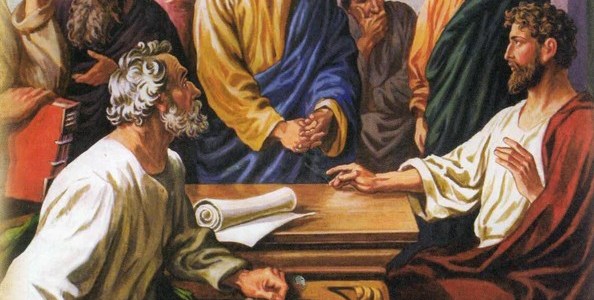
In Acts chapter 15, the Jerusalem Council addresses a dispute in which certain Judahites were teaching that “gentiles” must be circumcised and keep the Law of God in order to be saved. The issue at hand was not whether believers should live in obedience to God’s commandments, but whether such obedience is the basis of salvation. The Council’s conclusion makes clear that salvation is not obtained through works of the Law, but through the grace of the Lord Jesus Christ. During this discourse the Apostle James proclaims that the conversion of the “gentiles” is the fulfillment of an Old Testament Prophecy.
Acts 15:13-17 states:
“And after they had held their peace, James answered, saying, Men and brethren, hearken unto me: Simeon hath declared how God at the first did visit the Gentiles, to take out of them a people for his name. And to this agree the words of the prophets; as it is written, After this I will return, and will build again the tabernacle of David, which is fallen down; and I will build again the ruins thereof, and I will set it up: That the residue of men might seek after the Lord, and all the Gentiles, upon whom my name is called, saith the Lord, who doeth all these things.”
The passage that James is referring to is in Amos chapter 9 concerning the restoration of the House of Israel after they were sent off into Assyrian captivity and punished for their sins.
Amos 9:1-10 states:
“I saw the Lord standing upon the altar: and he said, Smite the lintel of the door, that the posts may shake: and cut them in the head, all of them; and I will slay the last of them with the sword: he that fleeth of them shall not flee away, and he that escapeth of them shall not be delivered. Though they dig into hell, thence shall mine hand take them; though they climb up to heaven, thence will I bring them down: And though they hide themselves in the top of Carmel, I will search and take them out thence; and though they be hid from my sight in the bottom of the sea, thence will I command the serpent, and he shall bite them: And though they go into captivity before their enemies, thence will I command the sword, and it shall slay them: and I will set mine eyes upon them for evil, and not for good. And the Lord GOD of hosts is he that toucheth the land, and it shall melt, and all that dwell therein shall mourn: and it shall rise up wholly like a flood; and shall be drowned, as by the flood of Egypt. It is he that buildeth his stories in the heaven, and hath founded his troop in the earth; he that calleth for the waters of the sea, and poureth them out upon the face of the earth: The LORD is his name. Are ye not as children of the Ethiopians unto me, O children of Israel? saith the LORD. Have not I brought up Israel out of the land of Egypt? and the Philistines from Caphtor, and the Syrians from Kir? Behold, the eyes of the Lord GOD are upon the sinful kingdom, and I will destroy it from off the face of the earth; saving that I will not utterly destroy the house of Jacob, saith the LORD. For, lo, I will command, and I will sift the house of Israel among all nations, like as corn is sifted in a sieve, yet shall not the least grain fall upon the earth. All the sinners of my people shall die by the sword, which say, The evil shall not overtake nor prevent us.”
The opening portion of this chapter describes the sinfulness of the House of Israel and the judgment that God declares upon them, including the removal of their kingdom. However, it also emphasizes that God would not “utterly destroy the house of Jacob.” Instead, He would sift them among the nations like grain, preserving a remnant and ultimately pointing toward a future restoration of the House of Israel.
Amos 9:11-12 states:
“In that day will I raise up the tabernacle of David that is fallen, and close up the breaches thereof; and I will raise up his ruins, and I will build it as in the days of old: That they may possess the remnant of Edom, and of all the heathen, which are called by my name, saith the LORD that doeth this.”
The passage above is what James is referencing in Acts 15 in relation to the conversion of the “gentiles.” It is important to note that James is drawing from the Greek Septuagint, which results in a different rendering of verse 12 compared to the King James Version and other translations based on the Masoretic Text. In my view, the Septuagint reading provides the clearest sense of the passage, and since it is the version used by the Apostle James, I regard it as the most appropriate rendering. Below are several English translations of the Septuagint text for verse 12:
Amos 9:12 (Brenton LXX Translation) states:
“that the remnant of men, and all the Gentiles upon whom my name is called, may earnestly seek me, saith the Lord who does all these things.”
Amos 9:12 (Apostolic Bible Polyglot LXX Translation) states:
“so that the ones remaining of the men should inquire and all the nations, the ones of whom my name was called upon by them, says the Lord, the one doing these things”
A common interpretation of Acts 15 is that non-Israelite “gentiles” are being brought into the covenant and thereby become spiritual Israelites. However, this view raises an important question in light of the passage James quotes from Amos: the original context is about the restoration of the House of Israel. Not non-Israelites becoming spiritual Israelites. Given this, it is necessary to ask who the “nations” are in verse 12 that are described as being “called by my [God’s] name.” The following are passages in the Old Testament where this expression is used:
2nd Chronicles 7:10-14 states:
“And on the three and twentieth day of the seventh month he sent the people away into their tents, glad and merry in heart for the goodness that the LORD had shewed unto David, and to Solomon, and to Israel his people. Thus Solomon finished the house of the LORD, and the king’s house: and all that came into Solomon’s heart to make in the house of the LORD, and in his own house, he prosperously effected. And the LORD appeared to Solomon by night, and said unto him, I have heard thy prayer, and have chosen this place to myself for an house of sacrifice. If I shut up heaven that there be no rain, or if I command the locusts to devour the land, or if I send pestilence among my people; If my people, which are called by my name, shall humble themselves, and pray, and seek my face, and turn from their wicked ways; then will I hear from heaven, and will forgive their sin, and will heal their land.“
It is clear from the context of the above passage that the people being spoke about are Israelites.
Isaiah 43:1-7 states:
“But now thus saith the LORD that created thee, O Jacob, and he that formed thee, O Israel, Fear not: for I have redeemed thee, I have called thee by thy name; thou art mine. When thou passest through the waters, I will be with thee; and through the rivers, they shall not overflow thee: when thou walkest through the fire, thou shalt not be burned; neither shall the flame kindle upon thee. For I am the LORD thy God, the Holy One of Israel, thy Saviour: I gave Egypt for thy ransom, Ethiopia and Seba for thee. Since thou wast precious in my sight, thou hast been honourable, and I have loved thee: therefore will I give men for thee, and people for thy life. Fear not: for I am with thee: I will bring thy seed from the east, and gather thee from the west; I will say to the north, Give up; and to the south, Keep not back: bring my sons from far, and my daughters from the ends of the earth; Even every one that is called by my name: for I have created him for my glory, I have formed him; yea, I have made him.”
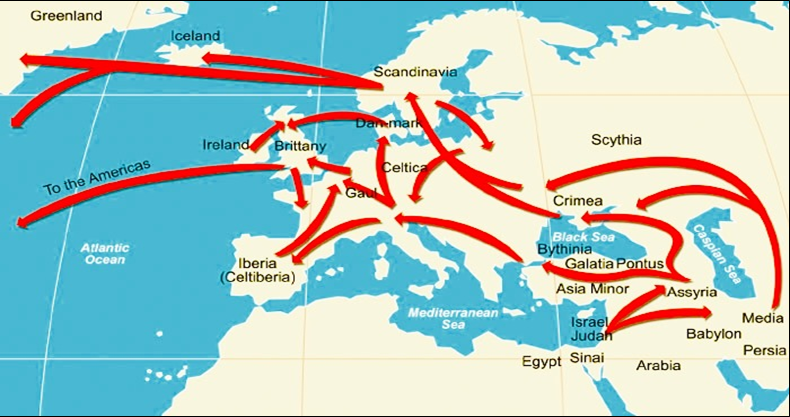
Once again, it is clear from the context of the above passages that the people being spoke about are Israelites. It would be logical that the same people spoken about in these passages, are also the same nations being spoken about in Amos 9 since the House of Israel was prophesied to be many nations and promised to be restored again back to God. We know that the “gentiles” in Acts 15 were the white Caucasian Romans, Greeks, and related peoples. This would mean that these peoples are in fact descendants of the Northern House of Israel which were promised to be reconciled back to God. This is confirmed by the Apostle Paul in his epistle to the Romans where he identifies these “gentile” people as the House of Israel by quoting a prophecy in a similar fashion as James does in Acts 15:
Once again, the context of the passage indicates that the people being discussed are Israelites. It is therefore logical to understand the same group referenced here in these passages are the same nations spoken of in Amos 9, since the House of Israel was prophesied to become many nations (Genesis 17, Hosea 1, etc.) and later restored to God. We know that the “gentiles” in Acts 15 were the white Caucasian Romans, Greeks, and related peoples. This would mean that these peoples are in fact descendants of the Northern House of Israel which were promised to be reconciled back to God. This is confirmed by the Apostle Paul in his epistle to the Romans where he identifies these “gentile” people as the House of Israel by quoting a prophecy in a similar fashion as James does in Acts 15:
Romans 9:24-26 states:
“Even us, whom he hath called, not of the Jews only, but also of the Gentiles? As he saith also in Osee, I will call them my people, which were not my people; and her beloved, which was not beloved. And it shall come to pass, that in the place where it was said unto them, Ye are not my people; there shall they be called the children of the living God.”
If you read the passage from Hosea that Paul is referring to it reveals that Hosea is speaking of the House of Israel and the House of Judah, which gives us the context that Paul is using to speak to these Jews (Judahites) and the “gentiles.”
Hosea 1:9-11 states:
“Then said God, Call his name Loammi: for ye are not my people, and I will not be your God. Yet the number of the children of Israel shall be as the sand of the sea, which cannot be measured nor numbered; and it shall come to pass, that in the place where it was said unto them, Ye are not my people, there it shall be said unto them, Ye are the sons of the living God. Then shall the children of Judah and the children of Israel be gathered together, and appoint themselves one head, and they shall come up out of the land: for great shall be the day of Jezreel.”
Conclusion:
Although much more could be said, the conclusion is that the “gentiles” in the Book of Acts were not non-Israelite peoples being granted a new identity as spiritual Israelites, but rather the fulfillment of God’s promise to restore and reunite the House of Israel and the House of Judah under one head—Jesus Christ. For more information on this topic, you can watch the videos below or read my book The Dispersed of Israel: A Biblical Examination of the “Diaspora” for free by clicking HERE.

 Christian America Ministries